Showing posts with label Traditions. Show all posts

Saturday, 6 December 2014

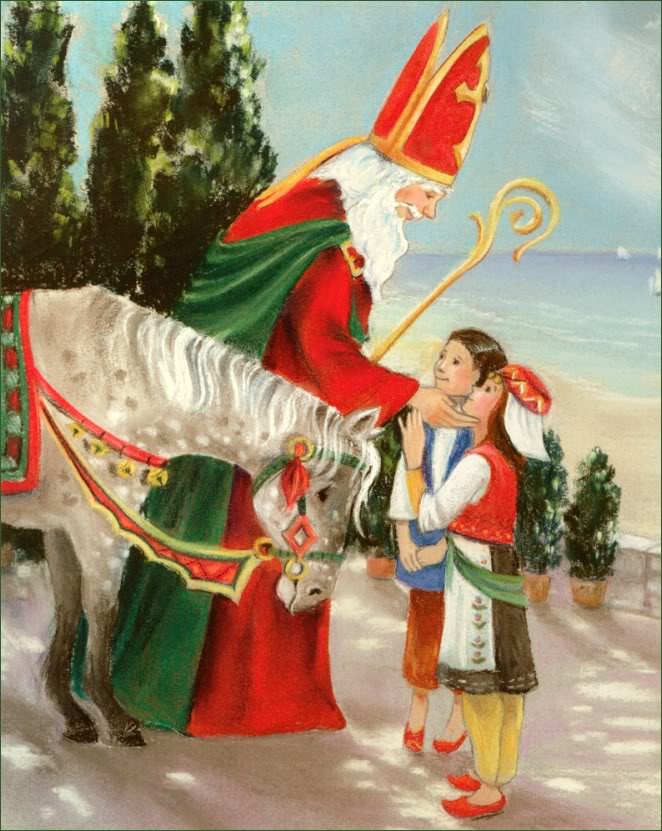
Saint Nicolas

Saint Nicolas, protector of children
The 6th December is Saint Nicolas' Feast Day. Saint Nicolas is the protector of children and there are lots of stories about how he saved children from kidnappers and butchers' cooking pots. He usually wears red and carries a rod/staff and sometimes a sack.

Father Christmas, Santa Claus, etc. are all ultimately based on this Christian Saint Nicolas tradition although Christmas and Saint Nicolas' Feast Day seem to have merged into one in the UK, and lost the religious connotations of Saint Nick.
Saint Nicolas,
just like Father Christmas

In France, this is celebrated in some areas (particularly in Lorraine and Calais, Brittany and Alsace). He travels around on a donkey that carries a basket laden with small presents (sweets, biscuits, fruit) for children, and has someone called 'Pere Fouettard' (the naughty butcher from one of the stories) follow him around. His name doesn't really have a direct translation but some people think he's the bogeyman.

Gold coins and treats in shoes
Fran and Charly decided this would be a thing for them so on Saint Nicolas' eve, they all put out shoes by the prayer corner (would have been fireplace, but there isn't one), and then overnight Saint Nicolas brought gold coins (those chocolate ones), a clementine and a small toy which are left in the shoes (like stockings on Christmas eve).

In the Netherlands, where Charly lived for a few years, they have someone called 'Zwarte Piet' or 'Black Peter' who is a very popular figure - I think he's supposed to be a Chimney Sweep. That's who is came with Saint Nick when visiting here! He travels with Saint Nicolas too and helps with the present delivering. If a child is good, they will get the coins from Saint Nicolas, but if they are bad, they will get coal or sticks instead from Black Peter.

The Dutch have Saint Nicolas parades where people used to paint themselves black and pretend to be Black Peter. I think Charly said this might now banned as it's just a tad racist...

More on Saint Nicolas here

More on Black Peter and Dutch Sinterklaas here

Saturday, 8 November 2014

Le Bleuet de France

Le Nouveau Bleuets de France
This year will be my first Remembrance Day not in England (it was also my first Bonfire Night not in England - the silence was very strange).

Charly received a package the other day which was full of 'Les Bleuets de France'. He's taken it upon himself to be a 'Bleuet' seller - being in the French military it's something of great importance to him.

Anyway, it turns out that France commemorates the 11th November here too! 

Thinking about it, it makes complete sense - they were involved in the World Wars too, they lost thousands of soldiers too... but it just never crossed my mind!


In France, 11th November is called ‘L’Armistice de la Guerre (1914-1918)’ or ‘The armistice of World War I’. (The French also have a second commemoration day on 8th May, the anniversary of the German surrender in World War II, known as ‘VE Day’ or ‘Victory in Europe Day’). It's also a Bank Holiday in France, so no school or work!

I feel I have a British obligation to explain to anyone not from UK or Canada, that we wear poppies as a symbol, 'lest we forget’ the soldiers who died in the World Wars. The poppy is the symbol for us in Great Britain because poppies grew in the fields the year following the battles where the ground had been churned up, and lots of men had died. There's also a famous poem called 'In Flanders Fields' by John McCrae.

*EDIT: I found out from the Jamaican Language Assistant that they wear poppies in Jamaica too - perhaps it's something lots of the Commonwealth states do??*

British Poppies
In France, they wear ‘bleuets’ (pronounced ‘blew-eh’) rather than Poppies. The Bluet is actually a cornflower - a blue wildflower often found in the countryside, sometimes considered a weed. The cornflower is thought of as a delicate, peaceful flower and is said to be ‘the bringer of a message of peace’ – a little bit like the white dove is. The bleuet was found on the battlefield too – and it carried on flowering even throughout the fighting.

The use of Bleuet de France (as a badge/charity item) actually came before the Poppy. During WW1, in 1916, nurses, war widows and wounded soldiers, handmade Bleuet from tissue paper, and later fabric to sell to raise money for hospital supplies to help wounded soldiers. Nowadays, they help to support war veterans (people who have fought in wars and survived), just like the Poppy.
Le Bleuet de France
2012  version (Fabric)

The brand new uniforms of the French soldiers for World War I were also blue and so their nickname was ‘bleuets’, even before the flower was sold.

There are some different designs of the bleuet de France, but they all mean the same thing. The new 2014 design of the bluet is also a reminder of ‘National Order of Merit’ (Ordre National du Merite) which is a special French military award. The 2012 version is made from fabric and a small bead.

The French also have a poem about their war flower symbol, called ‘Bleuets’ written in 1916 by Alphonse Bourgoin (it rhymes in the French version!):

These here, these little Bleuets,
These little bluets, the colour of the sky.
They are handsome, happy and stylish
Because there is no fear in their eyes.
Merrily, go forward,
Go on my friends, so long!
Good luck for you, our little blues.
Little bleuets, you are our hope.

Les voice les p’tits « Bleuets »
Les Bleuets couleur des cieux
ls vont jolis, gais et coquets
Car ils n’ont pas froid aux yeux.
En avant partez joyeux ;
Partez, amis, au revoir !
Salut à vous, les petits « bleus »,
Petits « bleuets », vous notre espoir ! »

So this year, I'll be sparing a thought for all the people around the world (particularly in Britain and France) - and remembering about all the soldiers that died in the World Wars.

Real 'Bleuets' or 'Cornflowers'


Monday, 6 October 2014

Fête de la Pomme

Fête de la Pomme
Jams and crates of apples
(in case you didn't want to PYO)
A Norman tradition, a bit like a country fair in celebration of the Apple, held in late September/October.

We went to one in Yvetot-Bge, near to Valognes on Sunday and met us with some of the family's church friends. It's quite normal for the hosting Orchard/Farm to open up their apple trees to public picking (which you then pay for at the end based on weight).

Apple Orchard
We bought a basket (from the basket weaver stall), and then went to pick some apples. Marc kept getting confused by 'to pick apples' in English and (I think) 'à pincer des pommes' (to pinch/steal apples) as 'pick' and 'pincer' sound similar and kept saying we were going to do that instead of 'à cueillir des pommes' (the french for picking apples).

Bakers Oven
There were also local farm shops selling their apple juice, cider, jams, duck and apple sauces, cider vinegar and cheeses. In addition to this, there were also some food stalls selling local sausage and chips, and a few craft stalls including apple themed artwork and a basket weaver.

Pomme de Pain
A Norman Man singing
There was a Baker who had come along to sell bread, which they were also baking in one of those old fashioned oven things on site. They were baking 'Pomme de Pain' too - a whole cooked apple encased in bread. It was tasty, but why wouldn't you core the apple first? You have to eat it with a knife so you can cut out the core and stalk before you eat it!

Later in the afternoon, they also had a local troop of traditional Norman folk dancers/ performers who arrived in full traditional Norman dress and put on a show on the stage. Marc loved this but Aurianne was tired so we had to leave before it had finished.

The Von Trapp Norman Family Singers
(we're convinced it was all one family!)
Norman Dancing
(Didn't get much more technical than skipping
round in circles, bowing and clapping)
Labyrinthe Vegetal
We also walked over to the farm just over the road, whose persistent French owner was insistent that all passers by should come in and try his 'Labyrinthe Végétal', basically a 'Maize Maze' in English. (Internet link here...) Apparently it's also known as 'La Clé des Champs' or 'The Key Fields'.

Which we did, and the children loved it. We didn't do it properly though as we had small people with us and only spent about 20 minutes in there before coming back out the way we came (Marie-Agnes had made leave signs on the ground so we could find our way out again).

Apparently it's supposed to take an average of 60-90 minutes!
A Path in the Maize Maze
Beautiful Blue Skies
Farmer had some giant rabbits
One of those 'Head in the Hole' photo boards. 
Flowers on a cart. The farmer/maze owner saw me
taking a picture and tried flogging them all to me!
"vous aimez? vous voulez acheter?
Oui, oui, vous pouvez en acheter un si vouz voulez!"

But first, let me take an Apple Selfie