Showing posts with label French History. Show all posts

Saturday, 6 December 2014

Saint Nicolas

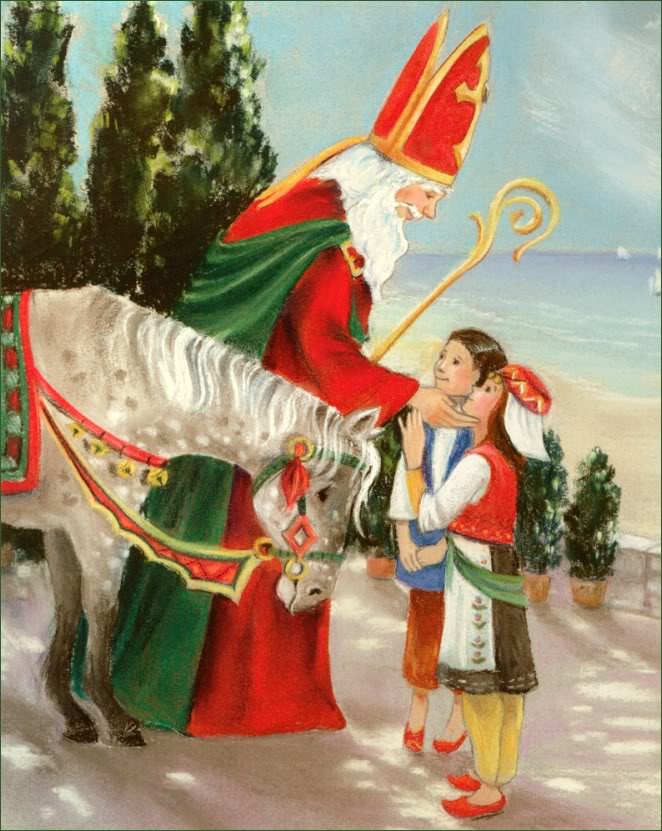
Saint Nicolas, protector of children
The 6th December is Saint Nicolas' Feast Day. Saint Nicolas is the protector of children and there are lots of stories about how he saved children from kidnappers and butchers' cooking pots. He usually wears red and carries a rod/staff and sometimes a sack.

Father Christmas, Santa Claus, etc. are all ultimately based on this Christian Saint Nicolas tradition although Christmas and Saint Nicolas' Feast Day seem to have merged into one in the UK, and lost the religious connotations of Saint Nick.
Saint Nicolas,
just like Father Christmas

In France, this is celebrated in some areas (particularly in Lorraine and Calais, Brittany and Alsace). He travels around on a donkey that carries a basket laden with small presents (sweets, biscuits, fruit) for children, and has someone called 'Pere Fouettard' (the naughty butcher from one of the stories) follow him around. His name doesn't really have a direct translation but some people think he's the bogeyman.

Gold coins and treats in shoes
Fran and Charly decided this would be a thing for them so on Saint Nicolas' eve, they all put out shoes by the prayer corner (would have been fireplace, but there isn't one), and then overnight Saint Nicolas brought gold coins (those chocolate ones), a clementine and a small toy which are left in the shoes (like stockings on Christmas eve).

In the Netherlands, where Charly lived for a few years, they have someone called 'Zwarte Piet' or 'Black Peter' who is a very popular figure - I think he's supposed to be a Chimney Sweep. That's who is came with Saint Nick when visiting here! He travels with Saint Nicolas too and helps with the present delivering. If a child is good, they will get the coins from Saint Nicolas, but if they are bad, they will get coal or sticks instead from Black Peter.

The Dutch have Saint Nicolas parades where people used to paint themselves black and pretend to be Black Peter. I think Charly said this might now banned as it's just a tad racist...

More on Saint Nicolas here

More on Black Peter and Dutch Sinterklaas here

Sunday, 23 November 2014

Omaha Beach - Débarquement de Normandie

On 6th June 1944, American, British (and Commonwealth) and Canadian (and French) troops landed on the coast of Normandy in what is now the best known D-Day landings.

For the sea invasions (there were also air strikes and parachute drops), the coast was split into 5 sections: Omaha, Sword, Juno, Gold and Utah. British troops landed on the Gold and Sword Beaches, Canadian troops landed on Juno, and the American troops landed on Utah and Omaha.

I went to visit Omaha beach, which is near to the village of Colleville-sur-Mer. This is the largest of the 5 landing beaches, and was also the setting for the bloody, but realistic, beginning scenes in the film 'Saving Private Ryan'.

The beach is beautiful. We arrived as the sun was setting and it was very serene and peaceful. Had we not been trying to get to the American Military Museum before it closed (and had we had better shoes) we may have walked along it, but instead we stood on the sand-dunes and looked across the beach and out to see.

It is very sad to think about the tragic events of 6th June 1944. We were able to liberate this area of France and then liberate Cherbourg, and then Paris, because of the brave acts of these men, which ultimately was a big part of the French liberation and the winning of the war. For this, so many soldiers sacrificed their lives, and I think it is important to learn about these fateful events and to remember what their sacrifice has done for the freedom and future of France, Great Britain and many other countries.

Also near to Colleville-sur-Mer, is the Omaha Beach Museum. Unfortunately we didn't get a chance to visit this either, but perhaps we will when we go to visit the American Military Cemetery, which is also situated near to Colleville-sur-Mer.

All of these sites should definitely be visited at some point. I think it is really important to appreciate the history and to remember the men who died during the war so that they are Never Forgotten.


Notre-Dame du Bessin | Cathédrale de Bayeux


Notre-Dame du Bessin
Notre-Dame du Bessin is the Cathedral of Bayeux (yeah, another Notre-Dame). It's huge!

We planned to just have a quick wander around the Cathedral, and then go find lunch.

Info about the Cathedral
It took us a little while to find the Entrance (it was around the other side) but we found it eventually.

We spent about 20 minutes walking around when I spotted some people coming down from a stair case in the wall. I was feeling rather curious, so me and Allison decided to go up there to see where it led.

Cathedrale of Bayeux
These spiral church steps were really dark and sketchy, and to be honest we really didn't feel like we were supposed to be going up there, but we just kept going anywhere. After a few minutes of climbing, we finally saw a room with some light so we went in there. I was so grateful for a rest - I was really out of breath (so unfit) and the spiral stairs had been quite creepy!
In the Knave of the Cathedral

The room we ended up in had a good view over the town of Bayeux and out towards some woods (which we were later told used to be where a big Castle was - but that got knocked down/destroyed during the revolution).

There was also a big display board with some information about a bell on it. It was all in French so I didn't take that long to look at it. After a few minutes, some other people came up the stairs.
Memorial Plaque for British Soldiers who liberated Bayeux,
and Poppy Remembrance Wreaths in the Cathedral

A man started talking to us in French (I had no idea what he was on about) and Allison said that he was asking if we were with a guide. He then asked 'are you going down? or staying with me?' - which I understood. We were a bit freaked out about going back down the dark steps on our own so opted to stay with the tour.

There was also a Canadian couple, a French couple and an older French man with the guide who were all quite nice.

He talked for about 5 minutes in French about the display board, which I (surprisingly was largely able to understand). It was all about a bell which was made this year to commemorate 70 years since the liberation of Bayeux.
Display board about the bell

This bell was commissioned by the Bishop of Bayeux, and (I believe) paid for by 10 different nations, including Great Britain, Canada, USA, Belgium, the Netherlands, and Germany, and has a patron from each country - the British patron of the bell is, naturally, HRH Queen Elizabeth II. However, Queen Liz wasn't able to make it to the ceremony for the bell on 6th June 2014 so Charles and Camilla came instead (Fran says Kate & Wills were at that too).

View across Bayeux
(the woods are where the castle was)
The 70th Anniversary Bell
The guide talked all about how it was made - by metal being poured into a Cast etc. and about how the bell handle is a claw.

He also talked about the design on the bell which are symbols to commemorate 70 years of peace, although I don't remember exactly what it was.

We then walked up yet more steps to the room with four Bells. This was really difficult to get to and the steps got really narrow.

In the room itself, there were wooden planks to stand on which made a walkway around the room, but it didn't feel especially safe! If you looked down between the wood structure and the stone walls you could see ALL the way down. Terrifying.

The Bell Tower, Notre-Dame du Bessin
Our guide switched to 'Franglais' around this time so we were able to understand a bit more of what he was saying. He rang a couple of the bells for us and told us that these four bells are only rung for ceremonies, and that there were other bells that were used for the time. I think the largest bell in that room was 2 tonnes. He said the other bells in the other tower were 3 and 4 tonnes!

In this room, he also showed us some really old graffiti which had been carved into the stone walls - one of the oldest ones we could see was early 17th Century! People had also used charcoal too, but some of the charcoal graffiti that was lower down had been rubbed away.

The Bells of Notre-Dame (du Bessin)
We walked through some more slightly scary steps, and through a narrow corridor which led to the other tower. Here he showed us the recent renovations of the belfry (apparently they had been swinging and knocking the wall every time they rang the bells!)

We walked back down some much safer looking steps (better lit and smooth rather than dark and bumpy) and ended up in yet another room. In this room we were offered drinks and snacks. Allison was feeling really uncomfortable about this as we think we may have had to pay for the tour, but as we hadn't...
Very old Graffiti!
You can see the bell carved into the stone!

It was possible to
go even higher!
In this room, the guide showed us the cover that had been made for the 70th Anniversary Bell. It looked like a robe and had lace edging and laced '70' on it. The older french man told us that this was 'Dentalle' which is a special kind of lacework done in Bayeux. Apparently it took over 300 hours to make!

We also found out that this 'cover' will go into the Cathedral treasury where they apparently have lots of other valuable things, once it has been on display.

The bell cover made from Dentalle lace
Very old belfries (over 400 years old)
After this, we climbed back down the stairs (so many stairs!) and ended up back in the main bit of the Cathedral (but on the opposite side as we'd crossed over to the other side).

We thought we might have to pay (not that we would have minded as it was an excellent little tour), but the guide just said 'à bientôt', we said 'merci' and that was that!

View from the first bell tower
across to the other tower.
A wonderful place to visit, and with the tour it was amazing! I would agree with TripAdvisor saying it's the #3 Attraction in Bayeux!

More photographs from our visit at the Cathedral...

Intricate decor at Bayeux Cathedral


Stained Glass Window


Inside the Crypt


Lovely remembrance candles


Surprised they didn't use
the 'Bluet de France' for these...


Statues of Angels in the Crypt

Decoration of the pillar arches in the Crypt


The Organ (in repair),
else the tour guide said
he would have shown us that too

La Tapisserie de Bayeux

They have a plaque outside the museum saying
Charles & Dianna visited in 1987
Like I said in 'Une Excursion en Normandie', we arrived at the Tapestry Museum just as the paydesk was closing at 11:45am, but we were still able to look at the Tapestry itself.

We were expecting to have to pay 9€ each to get in, but Allison asked what age the 'billet de Jeune' was and the receptionist said '18, ou étudiants' so we managed to get in for just 4€ instead. Excellent discount!

We got one of those handheld audio guides for viewing the tapestry (helpful as I wouldn't have had a clue what I was really looking at otherwise!) which talked you through the different scenes and the storyline.

Also, we apparently weren't supposed to take any pictures but there were no signs anywhere so we just went ahead without using the flash as that's a fairly common rule. However, one of the people who worked there came and told us 'no pictures at all' right when we were about to leave so we'd already done it so... Enjoy!

The Beginning
Old King Ed asks Harold
to go to Normandy
(Bayeux Tapestry Scene 1)
So for pretty much everyone, including those in the UK who learnt about it in Year 8 History and can't remember anything (like me), basically the story of the tapestry is this:

L'Histoire de la Bataille de Hastings

Off Harold sails to Normandy
(with the men wading into
 the Channel with bare legs)
(Bayeux Tapestry Scenes 4-5)
"Next stop, Brittany"
Harold: "Oops, wrong stop."
Breton King: "You can be my prisoner"
(Bayeux Tapestry Scenes 7-8)
King Edward of Wessex (I think) realises that he's getting a bit old and that he'll probably die soon. He has no children to pass the throne on to so thinks, 'hey, I was exiled in Normandy for 20 years and my best bud was a guy called William the Bastard (probably also a cousin), he will be my heir'. 


William (I think) says goodbye
to his girlfriend (the one under the arch)
 by patting her on the head.
(Bayeux Tapestry Scene 15)
So he calls his brother-in-law, Anglo-Saxon Harold, and says "Hey Harold, could you sail across the channel and tell my best bud William that he's gonna be King please?"


(Top-middle) An abbey on a mountain
by the sea with the words /
'Mont' and 'Michaels' next to it?
It's Saint-Mont-Michel!
(Bayeux Tapestry Scenes 16-17)
William: "You owe me"
Harold: "Don't worry. I promise you
will be the next King in England."
William: "Swear it on these treasures."
Harold: "Ok then."
(Bayeux Tapestry Scene 23)
So off Harold goes to France, but there's some bad weather and their boats get steered off course and end up landing in the hostile land of Breton (Brittany) where there is a not very nice king who makes Harold and his travelling companions prisoner.


Good ol' Will in Normandy hears about this and is not happy about it, so off he rides with an army of Normans to save Harold from Breton (which he does).


King Edward dies.
He is buried in Westminster Abbey.
The hand of God reaches down.
(Bayeux Tapestry Scene 25)
Harold is grateful, but William says, "well, I've done you a huge favour so you now must swear on some golden treasures that I will definitely be king when my best bud Eddie dies". 
Harold (Far left): "I am King"
Spies: "Tut tut, let's go tell William..."
*Spies go tell William* (to the right)
(Bayeux Tapestry Scene 31-32)

Harold swears on
the treasure.

There's a bit somewhere (I think before he makes the oath) in which William and Harold ride around France conquering various bits of land.
William builds some boats
so they can sail across
the Channel to go fight Harold.
(Bayeux Tapestry Scene 35)

Anyway, Harold goes back to England where Edward dies/has died. Harold suddenly has an ephiphany:
The Normans get lots of supplies
ready for the battle
eg. armor, weapons, food and wine
(Bayeux Tapestry Scene 37)

"The King is dead. William isn't here. I want to be King. No one can stop me. Oh, ok, I'll just be King".


However, there are some spies in Harold's court and one of them runs off back to Normandy to tell William what has happened.


Off they ride to Battle!
(Bayeux Tapestry Scene 51)
Williams says "Ohhh heeeelll naaw", though actually it would have been in Norman Latin.... 'Awww, non non non'? 
The Battle of Begins,
somewhere around the town of
Battle in East Sussex
(Bayeux Tapestry Scene 52)

William builds a huge Norman army, constructs boats, readies supplies and sets sail for England to take back 'his' land.

William arrives in the south of England and has a lovely time making himself at home. "Hi people, I am your new King". He has a few feasts and rests. They've got loads of time before Harold even finds out they're there.


The Battle rages on
(Bayeux Tapestry Scene 55)
Meanwhile, Harold and the Anglo-Saxon armies are up north fighting off some Danish vikings who are trying to invade somewhere around Scotland. They win, but word reaches them that William is invading back down south (somewhere near Portsmouth) so they make the 400 mile ride south.
Lots of men and horses die
(Bayeux Tapestry Scene 53)


I realised I didn't get a picture of this key part
so I've borrowed one from Wikipedia.
Harold gets struck in the eye with an arrow and dies.
The battle is over.
(Bayeux Tapestry Scene 57)
There is a huge battle in Sussex between the Anglo-Saxons and Normans where many people (and horses) die. This is called the Battle of Hastings, and happened in the year 1066 (948 years ago).

Partly because they were tired from the ride down, and because William was so well prepared, they don't do so well. Then, finally, Harold dies from getting an arrow in the eye so William wins.

William takes the throne and is henceforth (or maybe he was before) known as William the Conqueror.

The End.

And there you go. Apologies for any obvious factual inaccuracies and/or ad-libbing.

Here's a picture to show how long it is
(almost 70 metres), this is just one half!

Replica of an 11th Century warship
I found out loads of interesting stuff here. For example, apparently at the time, the priests/bishops went to war alongside the King (kind of like a good luck charm) but they weren't allowed a sword or bow because it was against the rules for them to kill. So, instead they had a staff to knock people out with.

We got kicked out at 12pm when they closed for lunch so we just went to the Cathedral and had lunch, and then went back at 2pm (thankfully the ticket is valid all day).
The museum is quite interesting. There is an interactive touchscreen computer with projections onto the wall which shows you the different scenes on the Tapestry with a description - very helpful if you were a bit confused by the story the first time!

A (rather life-like) statue of
an 11th Century King
There was a lot of information about the threads and dyes used, and a bit about how it would have been sewn. Apparently they used just three types of dyes to create (I think) 8-10 different shades and colours, which are not as clear as they would have been due to aging, but some of which are quite vibrant.

They also had some information about what had happened to the Tapestry between the time it was made and now, and about how they have to store it to prevent damage.

There are beliefs that the Tapestry was made to hang around the knaves in the Notre-Dame du Bessin Cathedral of Bayeux, as they believe it was commissioned by the Bishop of Bayeux (I think that was William's brother or something).

The tapestry also apparently has a piece missing - historians believe that there was more to it at the end but that it has been damaged.

It has also survived (I think) three fires in the Cathedral, during which times the Tapestry was there, some really shoddy 'renovation' work, and then during the Revolution some French people stole it and used it as a tarpaulin to hide weapons and other smuggled things out of the city of Bayeux, however they were stopped and someone realised what the tarpaulin actually was and it was returned safely.

Tiny models of different Anglo-Saxon forts or Norman castles.
They had tiny little animals and people on them,
some barely bigger than a large crumb!
There was also a lot of statues and little figures about life in the 11th Century in the museum, and about the building and architecture of castles, and then a section where you could see the studies of different sections of the tapestry in more detail - which we skipped as we wanted to see the film instead that started at 15:15 in English.

The film was quite good. It was only 16 minutes and we spent the first 5 thinking, 'we know all of this already' but it then went into some more detail about how the tapestry would have been sewn, and some of the speculations about it. It also involved mini-clips of battle re-enactments.

We left at about 3:30pm (much later than anticipated), but I think it was worth it to watch the film and take our time going around the museum!

Definitely worth a visit if you're ever in Normandy!